
“Explore” - An Exploratory Synthesis
Unifying Dark Matter, Dark Energy and Gravity
A. Gravity at a Planetary Scale – “Gravity Dynamics”
This section, Section 2, introduces an exploratory hypothesis, which I will call “gravity dynamics,” “GD.” This model postulates that gravity is not a fundamental force, but an emergent one. And it is repulsive, not attractive. The diagrams in Section 2 will show that there is no need for a four dimensional space time continuum or curved space or dark matter.
The subtopics below are:
A. Gravity on a Planetary Scale,
B. Gravity on a Galactic Scale,
C. Gravitational Time Dilation,
D. Dark Energy,
E. Stars (the Sun & Black Holes) and
F. Inertia - A Possible Explanation.
Section 2 matches the order of the list of issues in the previous Section 1, “Unresolved Issues.” The approaches used include diagrams, data and analyses. The illustrations below will show that GD could potentially explain most of the issues specified in Section 1, “Unresolved Issues.” The fact that it does so indicates that it should be considered seriously. However, only the section on “Explanations” for the Model”, Section 3, outlines the possible underlying mechanisms.
The Universe has various constituents. Some of these are well established, such as atoms and electrons; others are hypothesized, such as strings. I will refer to these collectively as “entities.” One or more of these entities in the universe produce outgoing waves, which I will refer to as “t-waves” because they are transcendent.
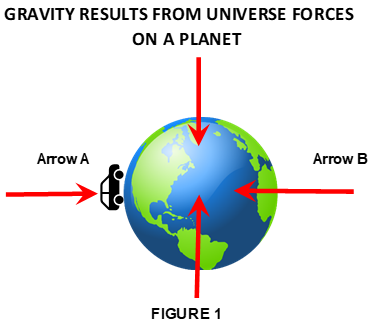
Figure 1 above illustrates the outgoing forces originating from the entire universe. The car on the left experiences a direct force as represented by “Arrow A.” However, the force on the right, “Arrow B,” is very slightly diluted as it must pass through the Earth. This left / right imbalance caused by this “blocking” is called gravity. The vertical arrows aren’t relevant in this case.
B. Gravity at a Galactic Scale – Dark Matter
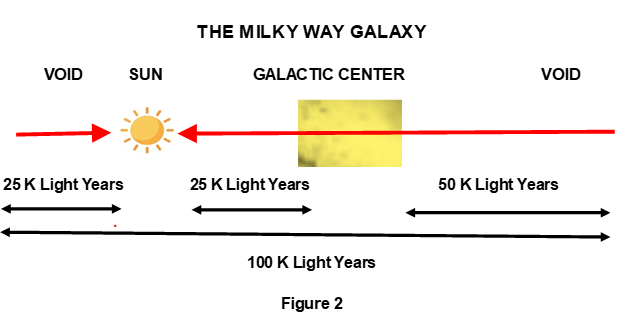
Figure 2 above, representing the Milky Way Galaxy, demonstrates that a galaxy is conceptually similar, on a large scale, to a large planet of low density; gravity therefore operates in a manner similar to that of a planet. The Milky Way is “100K” (one hundred thousand) light years across. Given that a light year measures six trillion miles, the distance across the galaxy is 600 quadrillion miles, where a quadrillion is a trillion times a thousand. The straight lines drawn pass through both the galactic center (with a supermassive black hole) and our Sun. The radius of the Milky Way is 50K light years. The Sun, in round numbers, is represented as 25K light years away from the center.
The Sun orbits the galactic center at 250 kilometers / second, but based on our understanding of gravity, the speed should be only 160 kilometers / second. (This is cited as item 1 on both the “Data” and “Sources” pages.) This discrepancy in orbital speed is an illustration of the “rotation” curve, and the proposed explanation is “dark matter.”
The Sun, given its location in the Milky Way, (using rounded numbers) is subject to an unbalanced force resulting from the greater weakening of universe waves from one side of the galaxy (shown on the right), a distance of 75K light years versus the other side, a distance of 25K light years. This is a difference of 50K light years, or 300 quadrillion miles. Over this enormous range, there is no clear path that avoids multiple bodies, even if they are very widely separated. These bodies include black holes, stars, nebulae, the interstellar medium and countless solar systems. The waves that impact the Sun from the left are stronger than those from the right. The Sun, therefore, to maintain its orbit, requires a greater velocity than is assumed in standard galactic celestial mechanics.
Dark Matter is unnecessary. Dark matter seems to be a "plug factor" that adjusts gravity equations that don’t work.
C. Gravitational Time Dilation
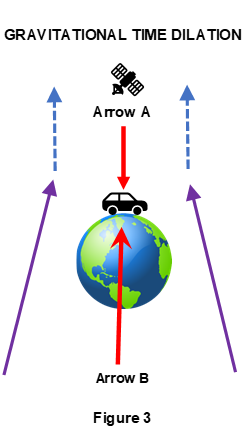
Gravitational time dilation occurs because the force on an object on the earth is unbalanced. Therefore, clocks run slower because they are in a denser net t-wave environment than exists further out in space. Time itself does not slow down – the motion of clocks slows down. Time is an abstract concept – motion isn’t.
For a satellite, this effect is diluted because the blocking is not as complete, as denoted by the diagonal, almost vertical lines. Accordingly, it is less affected by gravity / blocking at a height of 22,000 miles and runs faster than on earth. This requires an adjustment to make GPS work properly. Please see Figure 3 below.
D. Dark Energy
Gravity Dynamics provides a very simple explanation. Since repulsion is a natural feature of matter, the total effect is the expansion of the universe.
And, as noted before, how do we account for areas of the universe that are teeming with galaxies and other areas that are empty voids? It is simple. Where large objects are relatively close on astronomical scales, the blocking factor predominates, but where they are not the expansion rules.
E. Stars – The Sun and Black Holes
The Sun. That gravity travels at the speed of light does not cause the Earth to be thrown out of orbit is explained using relativity and the curvature of space: The eight minute delay is assumed irrelevant - the velocity-dependent terms in general relativity cancel out the eight minute propagation delay.
A simpler explanation is as follows: It is irrelevant that the Sun’s gravity is delayed by eight minutes. The Sun is not attracting Earth – it is merely slightly blocking forces from the universe, the result of which is a net attraction.
Bending of light by the Sun. This bending does not require curvature of space as an explanation, at least not entirely. Light slows down in gravitational fields; the portion of the light beam nearest a planet will slow down more than the tail end.
Black Holes. Black holes cannot shrink to zero because the outward force is always present. In addition, Loop Quantum Gravity, “LQG”, holds that at a very tiny size, matter is irreducible.
F. Inertia – A Possible Explanation
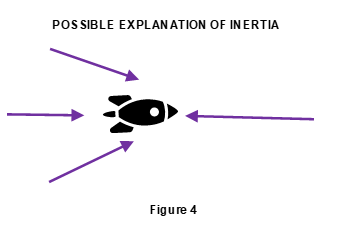
Figure 4, below, illustrates a rocket in uniform motion to the right. The t-waves would balance on both sides and there would be constant motion. The horizontal resistance force is greater on the right but the diagonal forces on the left make up for it. Only acceleration would be resisted.
Additional issues. The “Notes” section, items 2 and 3 in the “Sources / Notes” page mentions two additional items of interest related to galaxies and the rotation curve.